LOCAL SCHEMA: The Complete Guide to Local SEO Markup
Actionable LOCAL SCHEMA guidance for marketers and local businesses to win SERP features, improve NAP trust, and convert searches.
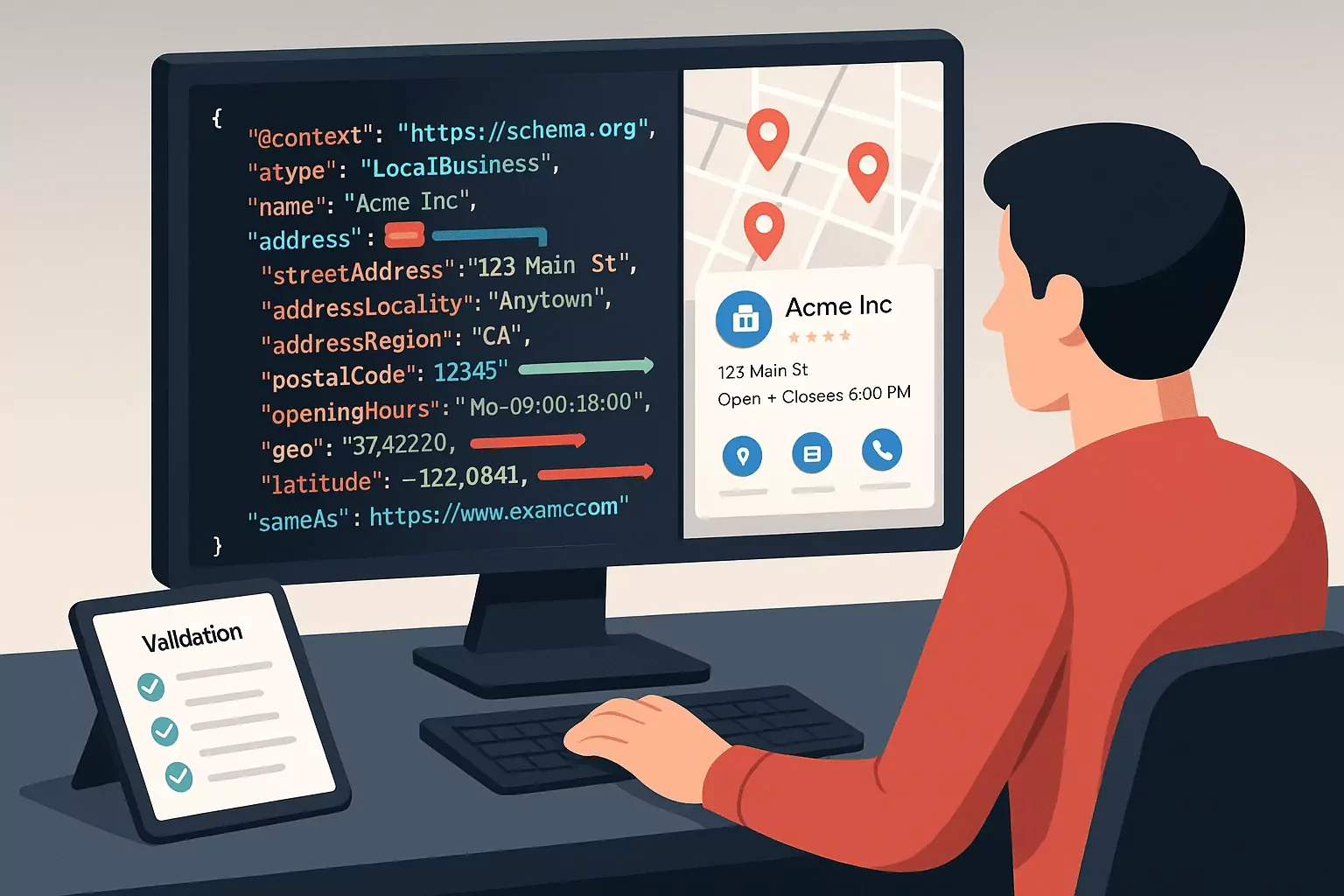
How LOCAL SCHEMA Works for Local SEO
Why Schema Markup Matters in Local SEO
LOCAL SCHEMA translates your real-world business details into structured signals search engines can trust. When your schema markup is complete, consistent, and accurate, Google more confidently displays rich results that attract qualified local clicks. This matters because local SEO depends on clarity around who you are, where you are, and what you offer. The more precise your data, the easier it is for algorithms to match you with high-intent searches. Strong markup shortens the path from query to action, leading to more calls, bookings, and foot traffic.
Done well, local business schema helps your brand surface in knowledge panels, map packs, and brand carousels. It complements on-page content by confirming the essentials like legal name, address, hours, and categories. JSON-LD keeps implementation maintainable and less error-prone compared with inline microdata. Pairing markup with on-page NAP consistency stabilizes your authority across directories and your Google Business Profile. Over time, these trust signals stack, strengthening overall local SEO performance.
Key Ranking Signals Enhanced by LOCAL SCHEMA
Search engines evaluate proximity, relevance, and prominence, and LOCAL SCHEMA supports each dimension. Proximity benefits from accurate geo-coordinates, full addresses, and service areas defined in your JSON-LD. Relevance improves when your schema markup aligns categories, services, and keywords with your landing page content. Prominence grows as you add reviews, ratings, and links to authoritative profiles that validate your entity. Together, these elements make local SEO more predictable and scalable.
Local business schema also enriches context with opening hours, payment types, and attributes like wheelchair access or delivery. Consistent identifiers-such as sameAs links to your Google Business Profile, social profiles, and key directories-tie your entity graph together. Marked-up phone numbers, menu URLs, and booking links tell Google what actions to show. As this data stabilizes, impression quality rises and click friction falls. The result is a stronger funnel from SERP to sale.
Aligning Google Business Profile With Markup
Your Google Business Profile acts as a primary authority for local facts, so it must mirror your LOCAL SCHEMA. Ensure the exact business name, address, and phone match across both, including suite numbers and abbreviations. Align categories and business hours, then reflect special hours and holiday closures in JSON-LD. If you publish menu, services, or booking links, keep the same URLs and labels in both systems. This consistency reduces conflicts that can suppress rich results.
Include sameAs references to your Google Business Profile within your local business schema to strengthen entity connections. Keep attributes synchronized, such as wheelchair accessible entrances or online appointments. When updates happen in the dashboard, schedule JSON-LD updates alongside content and citation changes. That rhythm prevents drift that can confuse crawlers and weaken local SEO. Over time, this disciplined approach yields steadier rankings and better customer actions.
Structuring Your JSON-LD for LocalBusiness
Choosing the Right Local Business Schema Types
Start with schema.org/LocalBusiness, then specialize with subtypes to refine relevance. A Restaurant, DentalClinic, AutoRepair, or Store subtype helps your LOCAL SCHEMA match user intent and SERP features. Include @type arrays if your business spans valid categories without stretching credibility. Your local business schema should reflect what customers would see on your storefront and on your site. Keep categories intuitive and avoid stuffing multiple unrelated types.
Within your schema markup, populate essential fields that represent how you serve customers. These include name, address, telephone, geo, openingHoursSpecification, image, url, and sameAs. Add areaServed, priceRange, and hasMap if relevant, then link to menus, products, or services pages. For regulated industries, include identifiers and professional accreditations where supported. This clarity sets the stage for stronger local SEO outcomes and richer result types.
Building JSON-LD That Scales
Design JSON-LD to be modular, versioned, and easy to update as your business evolves. Keep data in a central source of truth so hours, URLs, and phone numbers stay consistent across templates. For multi-service pages, reference the same organization and location nodes to avoid fragmentation. Use IDs (@id) to anchor entities and prevent duplicates in your LOCAL SCHEMA graph. This approach makes audits, merges, and future enhancements far simpler.
As you expand, attach Product, Service, Offer, or Menu markup to strengthen topical depth. Add Review and AggregateRating nodes when policy-compliant to improve credibility signals. Where relevant, include hasMap and geo for clarity in navigation and directions. Validate frequently to catch syntax errors that can nullify entire blocks of schema markup. A scalable foundation ensures local SEO gains compound rather than reset.
Handling Multi-Location Data in LOCAL SCHEMA
Multi-location brands should model one Organization with multiple LocalBusiness locations. Assign a unique @id to each location and maintain distinct NAP and geo coordinates. Keep consistent branding via the parent Organization node while tailoring hours and attributes per location. Link each location to its city landing page for context and crawl efficiency. This preserves clarity while letting each site section rank for its market.
Synchronize each location's Google Business Profile with the matching local business schema. Replicate core attributes like categories, services, and booking links at the location level. Use JSON-LD to reflect localized offers or events without confusing brand-wide details. Monitor GSC and call-tracking separately per location to measure local SEO impact. With disciplined data governance, LOCAL SCHEMA scales without diluting entity quality.
Optimizing Local Business Schema for Conversions
Service, Menu, and Product Details in Schema Markup
Move beyond the basics by marking up services, menus, and flagship products with schema markup. Use Service with detailed descriptions, areaServed, and offers to surface action-oriented snippets. Restaurants should use Menu and hasMenuSection with item URLs that match on-page content. Retailers can leverage Product with Offer details like price, availability, and condition. Align every field with visible content to maintain compliance and trust.
LOCAL SCHEMA that highlights next steps makes SERPs feel like your storefront. JSON-LD can point to booking URLs, ordering links, or appointment widgets customers already use. Reinforce consistency by matching anchor text and destination URLs with your Google Business Profile. This coherence helps local SEO by reducing ambiguity around the best action for each query. The payoff is higher click-through and more qualified conversions.
Reviews, Ratings, and Trust Signals
Social proof accelerates decisions, and local business schema can responsibly surface it. When policy allows, implement AggregateRating and reference first-party or third-party reviews you're permitted to show. Ensure the rating count and value match visible content and source policies. Use sameAs to connect to authoritative review profiles for additional credibility. This transparency strengthens both schema markup integrity and customer confidence.
Trust also grows with clear policies, staff credentials, and service guarantees marked where supported. Add attributes like paymentAccepted, currenciesAccepted, and delivery options to reduce friction. Keep brand imagery and logos consistent across JSON-LD and your Google Business Profile. With reinforced signals, local SEO gains extend from impressions to measurable revenue. The outcome is a SERP presence that feels complete, credible, and actionable.
Event and Offer Enhancements with JSON-LD
Events and promotions bring urgency, and JSON-LD helps them shine in search. Mark up Event with startDate, endDate, location, and offers for tickets or RSVPs. Use Offer with priceValidUntil to convey scarcity for seasonal services or sales. Keep details synchronized with your landing page and advertising to avoid mixed signals. These enhancements can lift CTR during peak demand periods.
LOCAL SCHEMA should separate evergreen content from time-bound data to prevent stale snippets. Version your promotions and clean up expired Event and Offer nodes promptly. Align UTM-tagged URLs in markup with tracking in analytics for clarity. When combined with local SEO fundamentals, timely enhancements create repeatable revenue spikes. The synergy is strongest when your Google Business Profile posts mirror the same details.
Validation, Publishing, and Troubleshooting
Testing LOCAL SCHEMA Before You Ship
Validate every change with Google's Rich Results Test and the Schema Markup Validator. Check that all required and recommended fields are present and accurate. Confirm your @id references resolve consistently across the site. Crawl templates in staging to ensure JSON-LD renders server-side or via hydrated scripts. This discipline prevents costly errors that can suppress rich results sitewide.
After publishing, watch Search Console for enhancement reports and warnings. Compare impressions and CTR for pages with updated LOCAL SCHEMA versus controls. Inspect cache and rendered HTML to ensure the markup is visible to crawlers. If you use tag managers, verify firing rules don't duplicate or block scripts. Continuous verification keeps your local SEO momentum intact.
Common Schema Markup Mistakes to Avoid
Inconsistent NAP across pages and profiles is the most frequent failure in schema markup. Avoid mismatched suite numbers, vanity numbers without canonical formatting, and conflicting hours. Don't mark up content that isn't visible on the page, which can trigger manual actions. Resist adding unrelated @types that dilute topical focus. Keep your JSON-LD free of trailing commas and syntax errors that invalidate blocks.
Another pitfall is outdated data that lingers for months after operational changes. Clean up expired offers, moved locations, and changed service areas quickly. Ensure your Google Business Profile and local business schema are updated in lockstep. Document processes so teams know when and how to modify JSON-LD. A tidy foundation strengthens local SEO and protects long-term trust.
Monitoring Impact in Search and Maps
Measure the lift from LOCAL SCHEMA using a mix of SERP, traffic, and conversion metrics. Track impressions, CTR, calls, direction requests, and bookings by page and by location. Segment brand versus non-brand local SEO queries to isolate discovery impact. Review map pack positions and driving-distance coverage for each market. Combine these insights to prioritize the next round of enhancements.
Correlate changes in JSON-LD with shifts in Search Console and GBP Insights. Watch query themes to ensure your schema markup supports evolving demand. If a feature drops, check for guideline updates or validator warnings. Iterate on services, offers, and review markup to restore eligibility. Continuous monitoring turns LOCAL SCHEMA into a durable competitive edge.
Frequently Asked Questions
What is LOCAL SCHEMA and how is it different from general schema markup?
LOCAL SCHEMA is structured data that describes real-world business details-like name, address, phone, hours, and geocoordinates-for local search. It focuses on entity clarity so Google can match you to nearby, high-intent queries. While general schema markup covers many topics, local business schema uses types such as LocalBusiness and its subtypes. It often ties to a Google Business Profile via sameAs links to reinforce identity. Implemented with JSON-LD, it helps unlock rich results, map visibility, and action buttons. The net effect is stronger local SEO backed by cleaner, more trustworthy data.
Do I need a developer to add JSON-LD local business schema?
You can add JSON-LD without a full rebuild, but a developer or technical SEO helps ensure accuracy and scale. Many CMSs support injection of schema markup via theme files or tag managers. A technical partner can normalize IDs, centralize data sources, and prevent duplication. They also validate changes, reducing the risk of broken eligibility for rich results. For small sites, trusted plugins can work, but you still need careful configuration. Regardless of approach, treat LOCAL SCHEMA as living data tied to operations, not a one-time task.
How often should I update LOCAL SCHEMA and Google Business Profile?
Update both any time core facts change-hours, phone numbers, addresses, services, or booking links. Schedule quarterly audits to catch subtle drift and expired offers. Align promotions so JSON-LD, landing pages, and your Google Business Profile reflect the same details. Refresh review markup as policies change and new testimonials are approved. Monitor Search Console and GBP Insights for anomalies that suggest data conflicts. Consistent upkeep keeps local SEO stable and your rich results accurate.